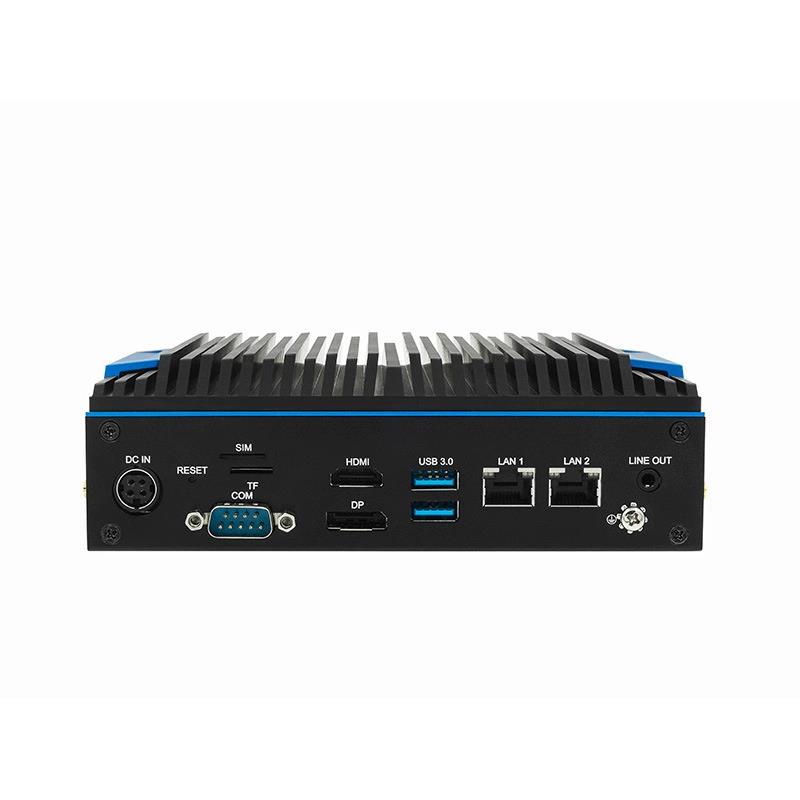
Detailed application directions built around one configurable C5 BOX platform.
6 TOPS NPU
AI engine
USB or network
Camera paths
Serial or GPIO
Control linkage
eMMC plus M.2 option
Storage
Why this application is difficult
Design for the real deployment, not only the demo.
Each page separates the hardware foundation from project-specific software, environmental, security and acceptance requirements.
01
Model accuracy is application-specific
Performance depends on product variation, defect definition, optics, lighting and the training dataset.
02
Cycle time controls the design
Image acquisition, preprocessing, inference and PLC response must fit the line takt time.
03
Camera compatibility needs evidence
Resolution, frame rate, transport, driver and trigger mode must be validated together.
04
False decisions have a cost
False rejects and missed defects need measured baselines and an escalation workflow.
Reference architecture
A clear path from source to business outcome.
Interfaces and responsibilities are frozen during feasibility review and verified with the target equipment.
IMAGE SOURCE
Industrial camera
USB or network camera with controlled lighting and trigger.
EDGE INFERENCE
C5 BOX + RKNN
Acquire, preprocess, infer and apply decision thresholds.
LINE LINKAGE
PLC or GPIO
Receive triggers and output pass, reject or alarm signals.
QUALITY SYSTEM
Records and review
Results, images, statistics and exception workflow.
Detailed capabilities
What the solution must do.
C5 BOX supplies compute and I/O. The complete solution includes project software, configuration, documentation and evidence.
Image acquisition
Define camera model, resolution, frame rate, exposure, trigger, lens and lighting before performance claims.
Model execution
Convert and benchmark the target model using the intended input size and quantization path.
PLC synchronization
Timestamp triggers and outputs, measure total response time and define timeout behavior.
Operator display
Show live status, result, exception image, recipe and basic production statistics.
Traceability
Store selected images and metadata with retention, naming and export rules.
Deployment method
Move from requirements to a repeatable rollout.
Use gated engineering steps so that performance, responsibility and support boundaries are visible before production.
01
Sample definition
Agree good/bad samples, defect taxonomy and acceptance thresholds.
02
Optics station
Freeze camera, lens, lighting, distance, trigger and product presentation.
03
Model benchmark
Measure FPS, P95 latency, memory use, temperature and accuracy.
04
PLC integration
Validate trigger, reject output, timeout and fail-safe behavior.
05
Pilot run
Run representative lots for 72 hours and review every false decision.
PoC and acceptance
Evidence to collect before production.
Acceptance criteria should be written into the PoC plan and measured under representative load and failure conditions.
Camera pipeline
Stable acquisition at the defined resolution, FPS and exposure conditions.
Inference performance
Measured average and P95 latency, throughput and thermal behavior.
Quality metrics
False-positive, false-negative, precision/recall and sample coverage.
Line response
Measured trigger-to-output time and defined timeout/fault state.
Data retention
Capacity, retention, privacy and export process for images and metadata.
Soak test
72-hour run with representative line speed, recipe changes and restart events.
Solution boundary
The integrated 6 TOPS NPU is suitable for validated lightweight workloads. Model compatibility, inspection accuracy and production speed must be proven with the actual camera, optics, dataset and line conditions.
Recommended starting configuration
C5-BOX
Finalize the SKU only after the interfaces, workload, environment, software scope and certification route are known.